The Potter’s House
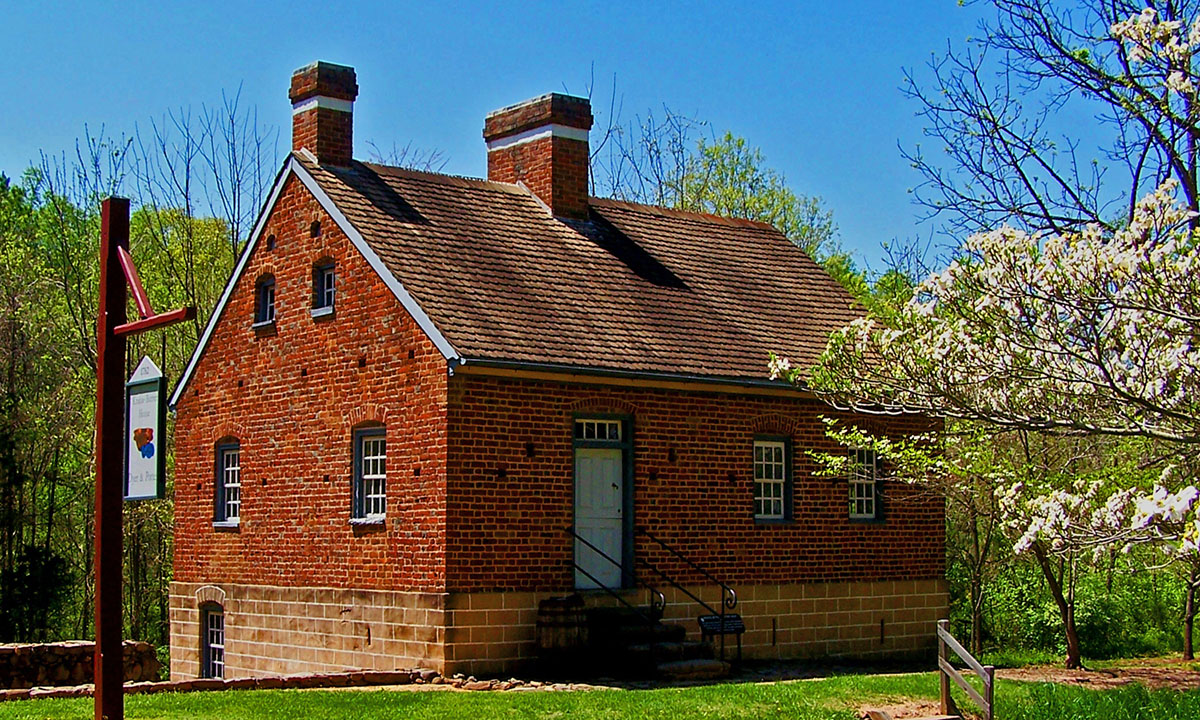
Johannes Schaub, Jr. and the American Revolution
The Moravians were pacifists in the 18th century. Because of their neutrality, they were viewed with suspicion by their neighbors, some believing they were secretly on the side of the Tories, others believing they sided with the Whigs. As tavernkeeper of Bethabara, Johannes Schaub, Jr. interacted with members of both sides on a regular basis. In February 1776, Colonel Armstrong arrived in Bethabara and exercised his company in front of the Gemeinhaus (the Bethabara church) before coming into the tavern. He and fellow officers asked Schaub, Jr. if the Moravians were storing ammunition for the royal Governor, and if they knew where a secret Tory gathering might take place. This led to accusations about things the Moravians supposedly said to non-Moravians, and Schaub, Jr. assured Colonel Armstrong these were all lies which had been started about the Moravians. The officers admitted then that they had been commissioned by the Committee of Safety in Salisbury to hold an investigation of the Moravian towns.
As pacifists, Moravians faced fines if they did not fight. In November 1778, Schaub, Jr. and three other Moravians were called up to the muster of Captain Schmidt’s army. The other married couples in Bethabara came together and raised 100£ to release the men from their obligations.
Throughout the war, troops from both sides came to Bethabara for food and provisions. As tavern keeper, Schaub, Jr. made many trips to Richmond to present bills for provisions furnished to American troops in order to be compensated. Sometimes the Moravians were repaid, but often they were not.
Perhaps tired of his duties as tavernkeeper, Schaub, Jr. received permission in 1780 to travel to the Moravian town of Bethlehem, PA to learn the trade of indigo dyeing. He returned in November of that year, very soon after the prisoners-of-war from the Battle of Kings Mountain left Bethabara. He set up his indigo dyeing shop in the old Single Brother’s House and began making plans to construct his own home and workshop space. He was able to do so in 1782 as the war began to wind down, hiring day laborers and building a bridge over the Grosse Johanna creek so that stone could be hauled to the location. He dug his own well and fired bricks for his building on site. The house was completed in October 1782, and he and his wife moved in. Schaub, Jr. used the basement as his dyer’s shop and the two rooms on street-level as his family’s home.
In 1789, Schaub, Jr. sold his home to potter Gottlob Krause. The Potter’s House continued to be inhabited by potters well into the 19th century.
Restoration Plans
The goal of Phase I is to preserve the Potter’s House by preventing further water-related damage. The objective is to replace the modern roof, gutters, and downspouts, which are at the end of their serviceable life, and to also redirect water away from the foundation of the building so that water no longer penetrates the basement.
Prior to starting this work, pre-preservation documentation will be created to make sure the building is restored as accurately as possible. Photogrammetry-based measured drawings, paint, finishes and materials analyses, and historical research and condition assessments will provide valuable data in moving forward with restoration and preservation of the building.
The Gemeinhaus
Restoration Plans
The goal of Phase I is to preserve the Gemeinhaus by preventing further water-related damage. The objective is to repair the belltower so that water no longer leaks inside. Water will also be redirected around the outside of the building so it does not seep into the basement.
Afterwards, the ceiling above the bell tower will receive new plaster, as well as a wall in the bedroom.
The funds for this restoration project come from the City of Winston-Salem.
The Distiller’s House
Restoration Plans
The goal of Phase I is to preserve the Distiller’s House by preventing further water-related damage. The objective is to replace the roof as well as the two-story porch. Water will be redirected away from the building.
The funds for this restoration project come from the City of Winston-Salem as well as the Bethabara Board of Trustees.